

A COMPLETE GUIDE TO LAND OWNERSHIP, LEGAL REQUIREMENTS, COSTS AND TRANSFER PROCEDURES
Learn how to acquire, transfer and register a title deed in your name in Kenya. Understand the legal process, required documents, Ministry of Lands charges, processing timelines and the importance of professional due diligence before purchasing land.

Buying land is one of the most important investments you can make. Whether you are purchasing affordable plots for sale in Kenya for residential development, commercial purposes, farming or future investment, having a legally registered title deed is one of the most important steps towards securing your ownership rights.
However, many land buyers in Kenya still have questions about title deed processing. When should you receive your title deed? What documents are required? How much does the Ministry of Lands charge? Can you transfer land into your name before completing payments? And how do you establish that the land you are purchasing is genuine?
At Prime Silver Investments Ltd, we believe that successful land investment begins with proper information, professional guidance and thorough due diligence.
This guide explains the title deed processing procedure in Kenya and what every prospective land buyer should know before committing their money.
1. What Is a Title Deed?
A title deed, commonly referred to as a certificate of title, is an official legal document issued through the land registration system as evidence of registered ownership of a particular parcel of land.
It identifies the registered proprietor and provides important information about the property, including its registration details, parcel number, tenure and any registered interests or restrictions affecting the land.
A title deed is important because it:
- Provides legal evidence of registered ownership.
- Identifies the registered owner of the property.
- Supports lawful transfer, sale, inheritance and other property transactions.
- Helps protect property interests against unauthorised transactions.
- Can be used in certain financing arrangements, subject to applicable requirements.
- Gives buyers greater confidence when investing in land.
However, it is important to understand that simply possessing a title deed does not automatically eliminate every possible land dispute. Buyers must still conduct an official land search, verify boundaries, confirm ownership history and investigate any existing cautions, restrictions, charges or competing interests.
2. When Do You Get a Title Deed After Purchasing Land?
The timing of receiving a title deed depends on the nature of the transaction and the property's registration status.
There are two common situations:
A. Purchasing land that already has an individual title deed

If you purchase a property with an existing individual title deed, the transfer process begins after the necessary contractual, financial and legal requirements have been fulfilled.
The seller executes the transfer documents, the relevant consents are obtained, stamp duty is assessed and paid, and the transfer documents are presented for registration.
Once the Land Registry registers you as the new proprietor, the updated title document or certificate of title is issued in your name, subject to the applicable registration process.
B. Purchasing a plot requiring subdivision and a new title deed

If you purchase a plot that is being subdivided from a larger parcel of land, additional procedures may be necessary.
These may include:
- Verification of the parent title deed.
- Surveying and establishing the subdivision boundaries.
- Preparation and approval of the subdivision scheme.
- Obtaining the relevant Land Control Board consent, where applicable.
- Processing mutation forms and cadastral records.
- Registration of the new parcels.
- Issuance of individual title documents.
This means that buyers purchasing subdivided plots should understand whether the title deed already exists or whether the subdivision and registration process is still pending.
At Prime Silver Investments Ltd, we emphasise transparency on title status so that our clients understand exactly what they are purchasing.
3. What Is the Legal Process of Transferring Land Into Your Name in Kenya?
Land ownership transfer is not completed simply because you have paid the seller or signed a sales agreement.
Under the Land Registration Act, a transfer is completed through the filing of the appropriate transfer instrument and registration of the buyer as the new proprietor.
The process generally follows these stages:
Step 1: Conduct an official land search
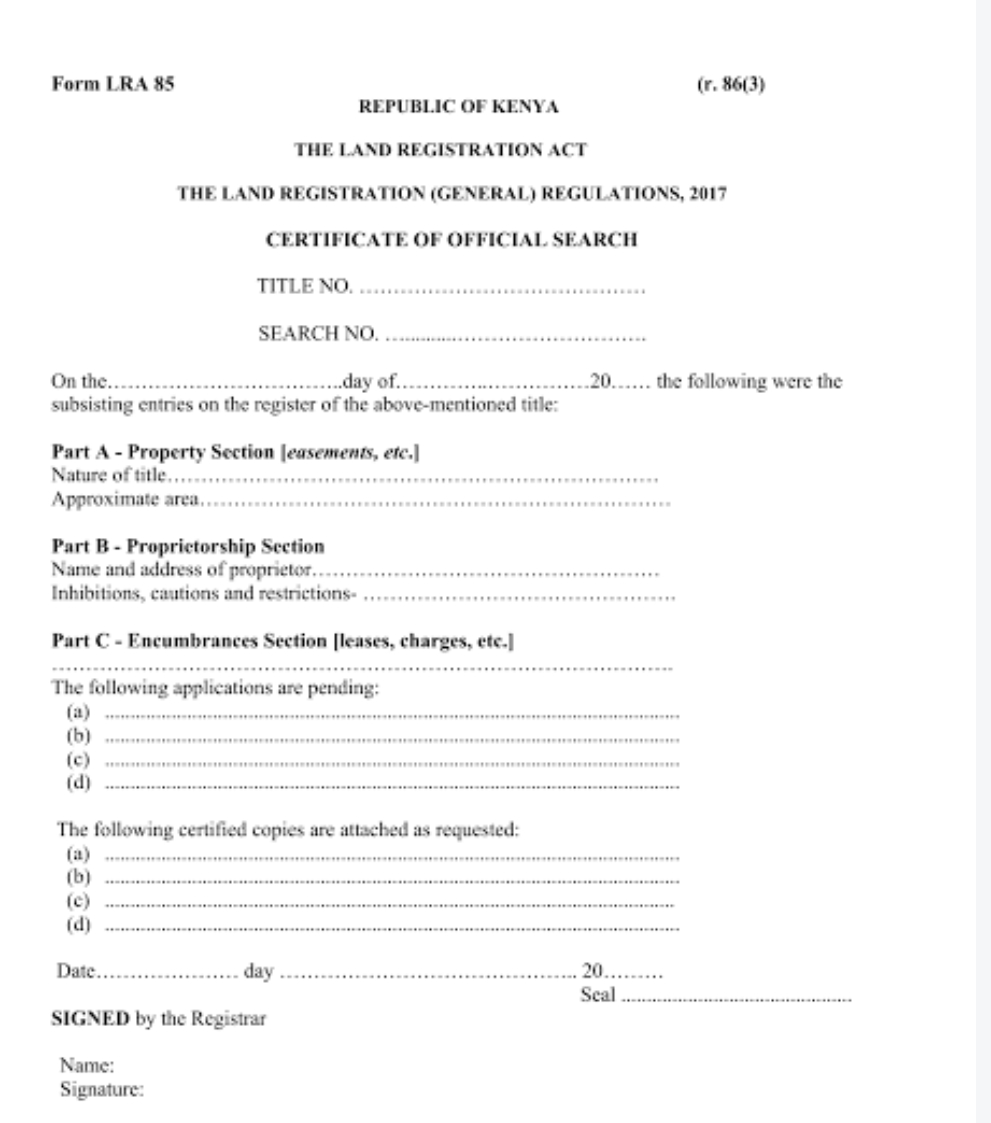
Before purchasing, obtain an official search from the relevant land registry or through the available government land services.
The search helps establish the registered proprietor and identify registered encumbrances, restrictions and other interests affecting the property.
Step 2: Engage an advocate
A qualified advocate should guide the conveyancing process, review ownership documents, prepare or review the sale agreement and advise on the legal requirements of the transaction.
Step 3: Execute the sales agreement

The buyer and seller enter into a written agreement outlining the purchase price, payment arrangements, completion period, obligations of each party and conditions governing the transaction.
Step 4: Complete the necessary payments and obtain consents
The parties fulfil the agreed financial and legal obligations. Where applicable, the necessary Land Control Board consent, land rates clearance and land rent clearance are obtained.
Step 5: Prepare and execute the transfer instrument
The appropriate transfer documents are prepared and signed by the parties in accordance with the legal requirements.
Step 6: Obtain a valuation for stamp duty
The property is submitted for valuation by the relevant government authority to determine the applicable stamp duty.
Step 7: Pay stamp duty
The buyer pays the assessed stamp duty through the prescribed KRA payment channels.
Step 8: Submit documents for registration
The executed transfer instrument, title documents, identification documents, payment evidence and other applicable supporting documents are lodged at the relevant land registry.
Step 9: Registration and issuance of the updated title
Upon successful registration, the buyer becomes the registered proprietor. The updated title documentation can then be collected through the prescribed procedure.
This is the legal process that changes registered ownership from the seller to the buyer.
4. Documents Required for Title Deed Transfer in Kenya
Proper documentation is essential to avoid delays and complications during title deed processing.
The following documents are commonly required, depending on the nature of the property and transaction:
From the seller:
- Original title deed or applicable title document.
- National Identity Card.
- KRA PIN certificate.
- Recent passport-size photographs.
- Duly executed transfer instrument.
- Land rates clearance certificate, where applicable.
- Land rent clearance certificate, where applicable.
- Relevant Land Control Board consent or other statutory consent, where applicable.
- Supporting ownership and transaction documents.
From the buyer:
- National Identity Card.
- KRA PIN certificate.
- Passport-size photographs.
- Payment evidence for the purchase price.
- Executed transfer documents.
- Stamp duty payment receipt.
- Other supporting documents required by the land registry.
Additional documents may be necessary for company-owned property, inherited land, leasehold properties, subdivisions, court-ordered transfers or transactions involving a power of attorney.
Always confirm the specific checklist with the advocate handling the transaction and the relevant land registry.
5. How Much Does the Ministry of Lands Charge for Title Deed Transfer?
One of the most frequently asked questions by land buyers is the cost of transferring a title deed.
The total cost depends on the property's government valuation, location, tenure and the nature of the transaction.
The main statutory charges include:
A. Stamp duty
Stamp duty is generally charged as follows:
- 4% of the assessed property value for property within municipalities and applicable urban areas.
- 2% of the assessed property value for property outside municipalities.
The applicable classification and assessment should be confirmed by the relevant authority.
B. Land registration fees
The government charges a registration fee for processing the transfer. The applicable amount should be confirmed using the current fee schedule and transaction category.
C. Title document fees
Applicable title or document issuance fees may also arise depending on the registration service being undertaken.
D. Other applicable charges
Depending on the transaction, additional costs may include:
- Land Control Board consent fees.
- Land rates clearance charges.
- Land rent clearance charges.
- Survey and mutation fees for subdivisions.
- Advocate's conveyancing fees.
- Official search fees.
- Other applicable government processing charges.
Important: Stamp duty is usually the largest government charge in a normal property transfer. It is calculated using the assessed property value, not necessarily the price stated in the sales agreement.
For an accurate estimate, buyers should request a breakdown before commencing the transfer.
6. How Long Does Title Deed Processing Take in Kenya?
Title deed processing time depends on the type of transaction, completeness of documentation, government approvals and the workload of the relevant offices.
For a straightforward transfer involving an already registered individual parcel, the registration stage can be relatively quick once all requirements have been met.
The Ministry of Lands' published service information and Kenya's eProcedures transfer guidance provide different timelines for individual stages. The overall transfer process may take approximately 20–51 days under the published procedure estimates.
However, this is not a guarantee. Delays may occur because of:
- Incomplete documentation.
- Outstanding land rates or rent.
- Delayed consent approvals.
- Errors in transfer instruments.
- Stamp duty valuation delays.
- Boundary or ownership disputes.
- Registry backlogs.
- Complications involving subdivisions.
At Prime Silver Investments Ltd, we prioritise efficient documentation, proper verification and timely follow-up to help our clients experience a smoother title deed processing journey.
For eligible and properly documented transactions, we aim to facilitate title processing within 14 days where the relevant approvals and registry procedures allow. This is a service target, not a guarantee of government registration timelines.